29th July 2026.
Introducing TOWN’s Impact Framework.
Share
We create homes and neighbourhoods that support individual wellbeing, stronger communities and a healthier planet.
Our new Impact Framework provides a consistent approach to achieving and measuring those ambitions. Applied throughout the development process, from site selection to post-occupancy, it helps shape design decisions, set measurable objectives and evaluate the long-term performance of our projects.
The framework combines recognised technical standards with social and environmental outcomes, allowing us to assess everything from energy use, biodiversity and carbon emissions to health, social connection, participation and long-term stewardship.
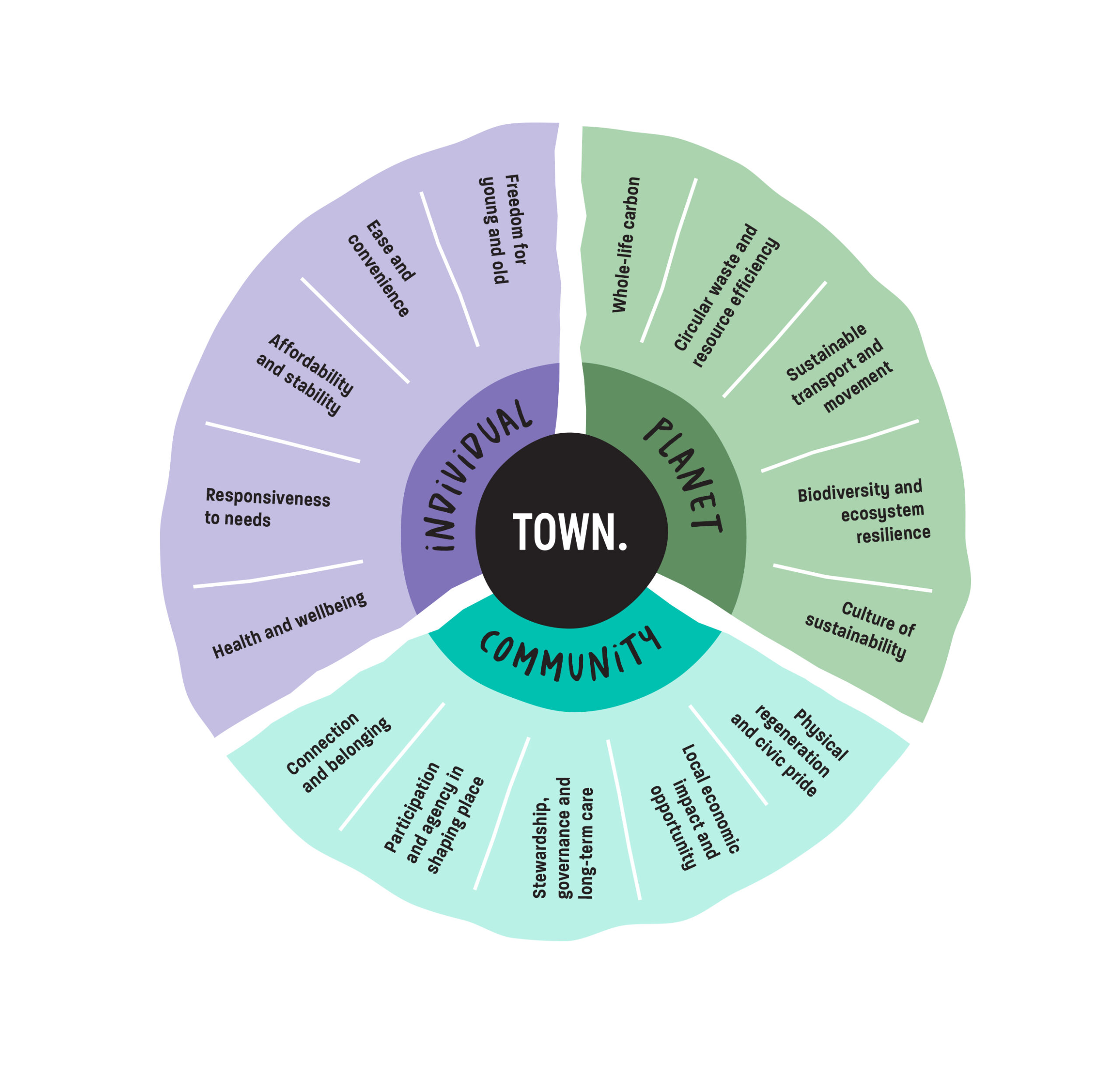
TOWN’s Impact Framework.
Why we’ve created it
Housing, and the built environment more generally, have a profound influence on how we live. It affects our physical and mental health, our opportunities to connect with neighbours, our impact on the planet and on all aspects of our quality of life.
Since TOWN was founded, we’ve sought to put these outcomes at the heart of development. Our first cohousing community, Marmalade Lane, received a host of national awards for design, planning and social impact, while our post-occupancy study Insights from Marmalade Lane has become a leading example of how completed places can be evaluated and improved. More recently, Love Wolverton has been recognised as an exemplar of mixed-use town centre regeneration, we are working in partnership with the Crown Estate at Hemel Hempstead to deliver a demonstration project, and our work with children and young people has helped raise awareness of how the built environment can better support younger generations.
Until now, we haven’t had a single framework for bringing together these different strands of our work or measuring our impact consistently across every project.
Our Impact Framework provides a clear structure for setting ambitions, informing decisions, evaluating trade-offs and measuring whether the places we create genuinely deliver lasting value for people, communities and the environment.
Three priorities
The framework is organised around three priorities: the wellbeing of individuals, communities and the planet.
Individual wellbeing
Our homes are designed to support health, comfort and independence throughout life. This includes creating adaptable homes that respond to changing needs, reducing running costs through energy-efficient design and locating homes within walkable neighbourhoods where everyday amenities are easy to reach.
Community wellbeing
Our projects create opportunities for neighbours to meet and build lasting relationships through shared spaces, resident participation and long-term stewardship. Codesign also plays a central role enabling future residents and local communities influence projects from an early stage.
Planetary wellbeing
Our projects aim to minimise harm to the planet, this includes looking at whole-life carbon, operational energy, biodiversity, sustainable transport and everyday behaviours that support lower-impact living.
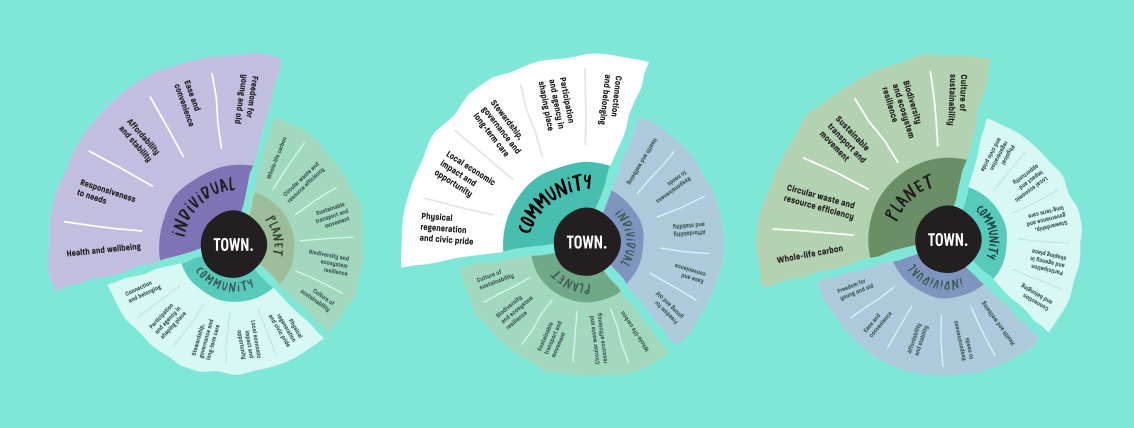
How we apply the framework
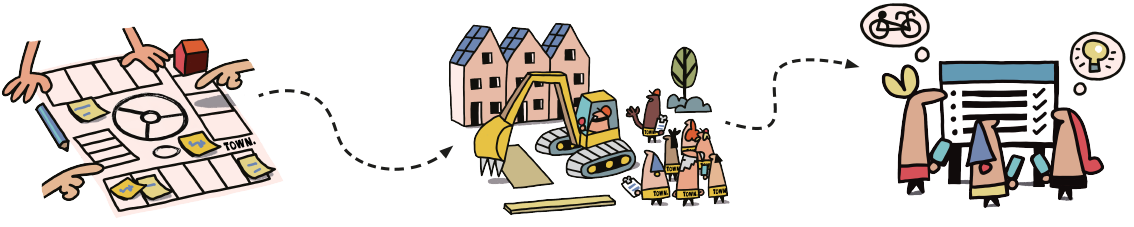
The Impact Framework is used throughout the life of every project. At the early stages, it helps us assess opportunities and identify where a project has the greatest potential to deliver positive social and environmental outcomes.
During design and delivery, each project is assessed against a series of measurable outcomes across the three themes. These range from daylight, thermal comfort and adaptability to biodiversity, carbon emissions, resident participation and long-term stewardship. Where possible, these outcomes are benchmarked against recognised standards, including the Nationally Described Space Standard, Building Regulations, Biodiversity Net Gain requirements and LETI guidance. Others measure qualities that are less commonly assessed, such as opportunities for informal social interaction, children’s independence, affordability, resident influence over design and access to shared resources.The framework helps project teams ask better questions, test design decisions and identify opportunities for improvement as schemes evolve.
Once projects are complete, the framework provides a basis for evaluation. We combine building performance data with post-occupancy research, resident interviews and observations of how spaces are used to understand whether the intended outcomes have been achieved. Those findings then inform future projects, creating a growing evidence base for what contributes to successful neighbourhoods.
Interested in creating places with lasting impact?
Whether you’re a landowner, local authority, investor or development partner, we’d love to explore how the TOWN Impact Framework could help shape your next project. Contact us: hello@town.co.uk.
Join our mailing list
For news and project updates