31st October 2026.
Halloween: a simple test for walkable neighbourhoods.
Share
It’s Halloween, and across the country children dressed as zombies, witches and assorted other ghouls, armed with pumpkin buckets, are venturing from door to door in the age-old tradition of trick or treating. But have you ever thought about how the design of your neighbourhood might affect the size of your Halloween haul?
A recent ranking of the UK’s best places to trick or treat has done just that. The analysis considered the density of occupied houses across more than 8,500 neighbourhoods and identified the Haslemere Road area of Southsea as the best location, with 13,860 houses per square mile.
It’s easy to see why. Southsea’s dense grid of Victorian terraced streets, with front doors opening directly onto the pavement, creates an ideal setting for trick or treating. More front doors within a smaller area means more opportunities to collect sweets without having to walk so far.
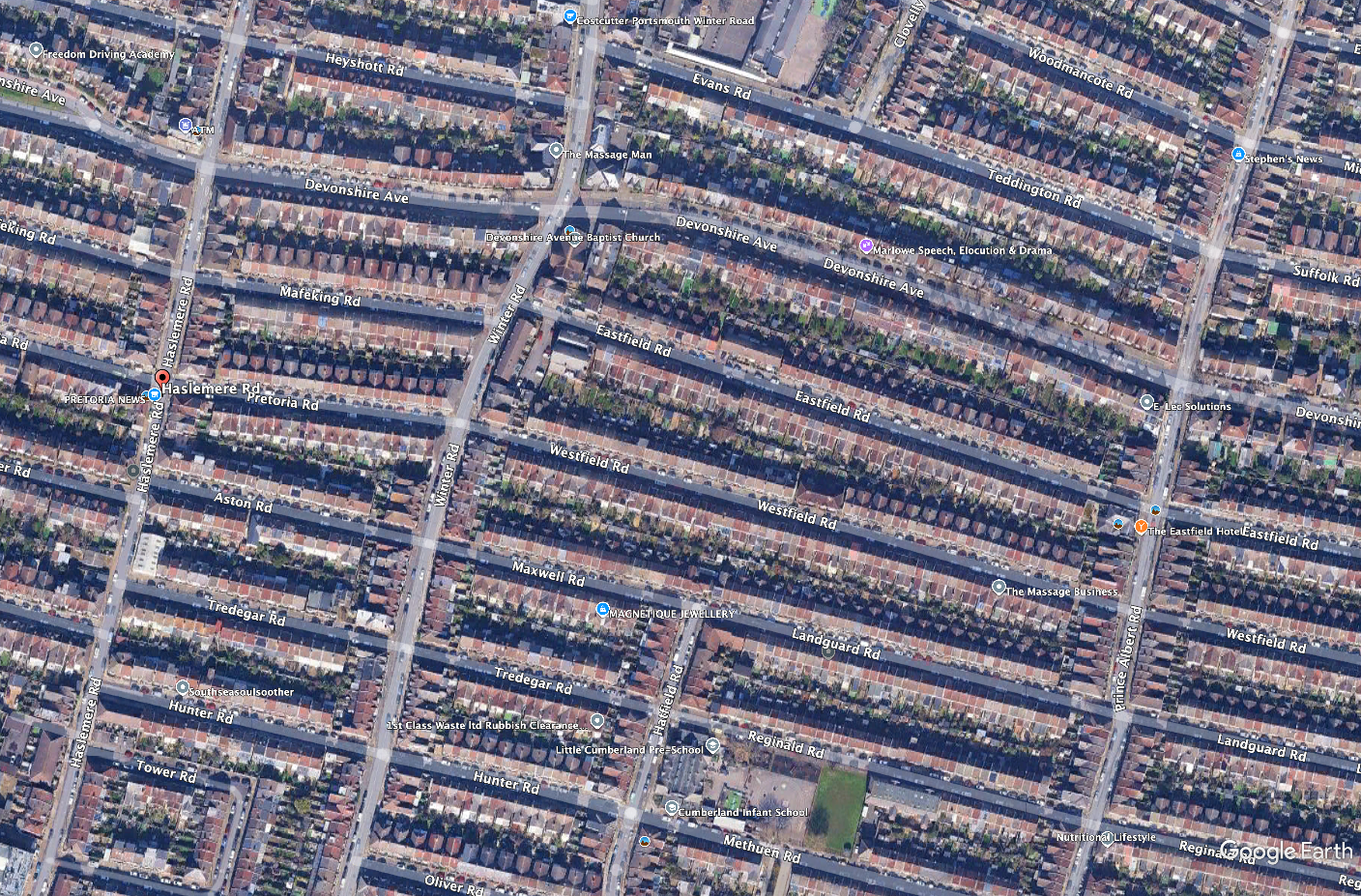
Southsea’s dense grid of Victorian terraced streets.
But as important as density is, it’s not the only ingredient in a successful Halloween expedition. Streets also need to be walkable, with low traffic speeds and safe routes for large numbers of children on foot. A quiet residential street, where cars move slowly and children can easily cross between houses, is likely to offer a better experience than a busy main road, however many front doors it might have.
Other attempts to identify the perfect trick-or-treating neighbourhood have taken a broader approach. In 2015, property website Zoopla published its own Trick or Treat Index, ranking towns and cities according to housing density, property prices, crime rates and pedestrian road safety. Property values were presumably included on the assumption that wealthier households might be more generous with their sweets. Milton Keynes came top, thanks in particular to its low crime rate, while Chesterfield, Middlesbrough and Hull were among the least promising destinations.
And in 2024, a survey commissioned by Haribo asked 1,000 children aged six to sixteen what they thought of trick or treating in their local area. Brighton came top, followed by Liverpool and Leeds.
The secret ingredient: neighbourliness
But beyond the physical layout of a neighbourhood, its density, safety and prosperity, there’s something else that matters just as much: a sense of neighbourliness and community.
After all, trick or treating relies on a remarkable degree of mutual trust between neighbours. On what other evening would it be considered perfectly acceptable to knock on a stranger’s door and ask for sweets? When else would parents happily encourage their children to do so? And when else would dozens of unexpected visitors knocking on the door throughout an evening be welcomed rather than regarded as a major nuisance?
It’s a cherished tradition that briefly transforms the relationships between people – fronts doors open, neighbours meet and share and communities come together. It offers a glimpse of the kind of neighbourliness that can sometimes feel lost in modern life.
Creating neighbourhoods for better lives
At TOWN, these are all qualities we seek to nurture in the neighbourhoods we create.
We build homes on streets that are safe and walkable, where children can play and explore, not just on Halloween but throughout the year. Streets where front doors and shared spaces encourage everyday encounters between neighbours. Places well connected to local services, employment and the wider community.
But we also recognise that good neighbourhoods are about more than their physical design. They’re about the relationships between the people who live there, and the opportunities to build trust, friendships and mutual support. At Marmalade Lane – TOWN’s first cohousing development in Cambridge – this sense of community is evident, with 98% of residents stating that they regularly stop and talk with neighbours, and 96% feeling able to go to a neighbour for advice.
Ultimately, the best test of a neighbourhood isn’t just how many sweets its children can collect on Halloween. It’s whether they feel safe and free to explore it, whether neighbours know and look out for one another, and whether people feel a genuine sense of belonging throughout the other 364 days of the year.
Explore TOWN’s Impact Framework to learn more about how we’re creating good places for better lives.

Join our mailing list
For news and project updates