14th May 2026.
TOWN at Footprint+: regenerative design is about more than minimising harm.
Share
TOWN Associate Director Guy Rochez recently joined a panel discussion on regenerative design at Footprint+, the UK conference focused on decarbonising the built environment.
The session was chaired by Will Arnold of Useful Simple Trust, with Guy speaking alongside Imandeep Kaur of CIVIC SQUARE.
Will’s keynote was centred around how regenerative design should be understood as a process rather than a fixed outcome. He spoke about how the sector can move beyond reducing harm towards creating places that actively repair social and environmental systems over time. Drawing on examples from across the sector, he spoke about the importance of thinking across three pillars of place, time and influence — recognising that buildings are shaped by both technical decisions and the long-term relationships between people, land, ecology and governance.
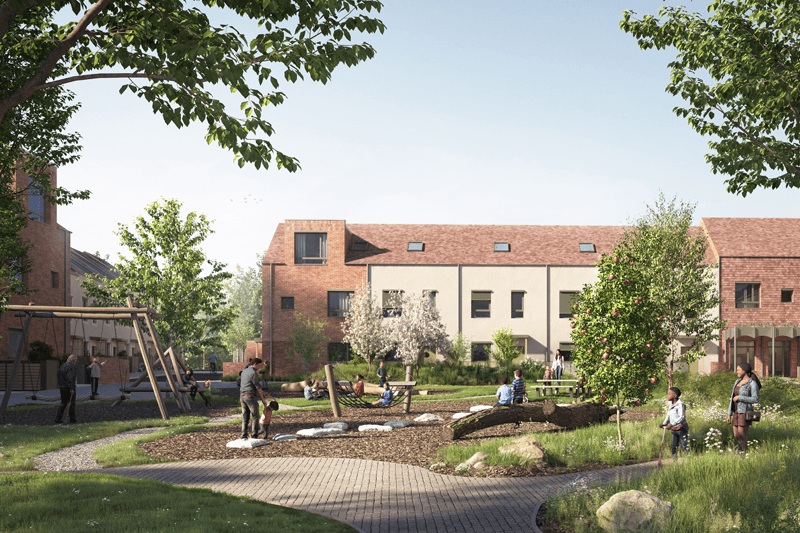
Communal gardens at Westwick Row.
Guy spoke about how this connects to TOWN’s approach to development. Across all our projects, TOWN’s focus is about creating places where communities have the ability to shape and care for neighbourhoods over time.
In our housing schemes, shared spaces and resident stewardship strategies have helped create places where people collectively manage communal gardens and common spaces, organise activities and support one another in everyday life. These communities often reach beyond the immediate neighbourhood, contributing to the wider civic and social life of the wider local environment.
This thinking also informs TOWN’s approach to engagement. On projects such as Westwick Row, local residents have been involved in a long-term codesign process exploring various aspects of the scheme from landscape and movement to water management and shared space. Processes like this allow local knowledge and lived experience to shape places as proposals evolve.
The discussion reflected a broader shift in the sector where conversations around regeneration are moving beyond operational carbon and technical standards alone towards larger questions about long-term stewardship, participation and resilience. For TOWN, that means recognising that places and not fully resolved at planning stage and continue to evolve long after construction finishes.
Join our mailing list
For news and project updates